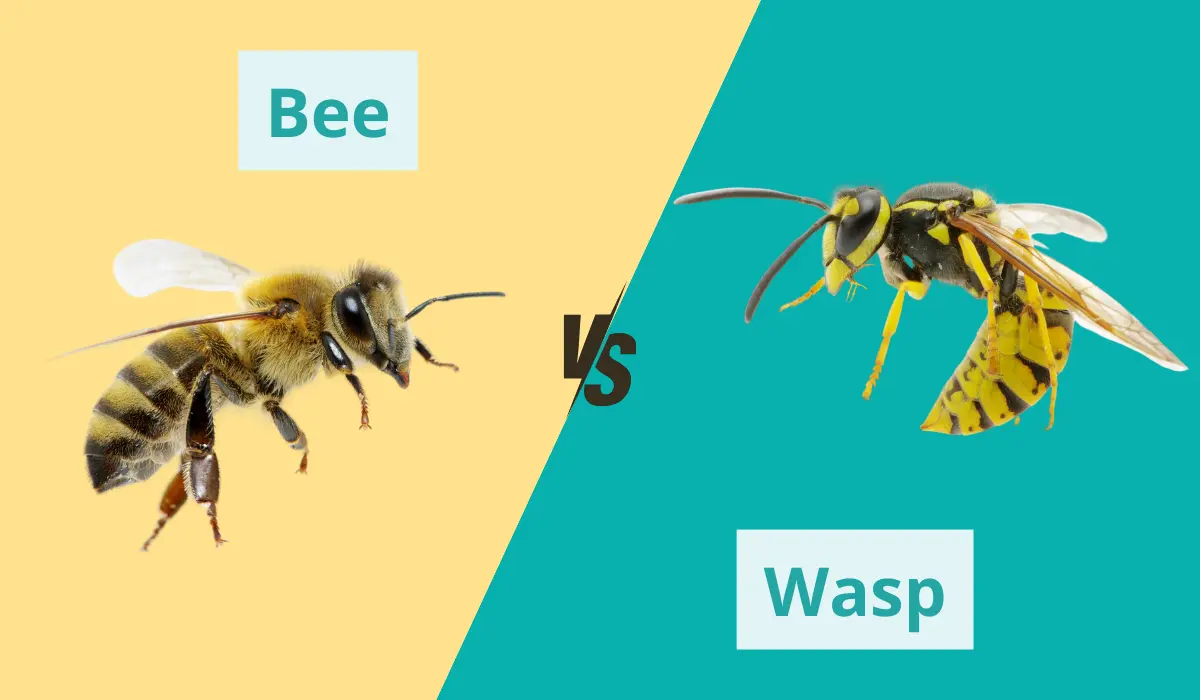
That buzzing near your porch could be a harmless honey bee passing through, or it could be an aggressive yellow jacket guarding a hidden nest. The difference matters more than you might think, especially when your next move determines whether you get stung once, stung repeatedly, or not at all.
Bees and wasps look similar from a distance, but their bodies, behaviors, and temperaments are worlds apart. This guide walks you through the most common species in Southern California, how to identify them, where they like to nest, and when a situation calls for professional help.
Bees and wasps both fly, both sting, and both show up uninvited on your property. Yet they’re actually quite different once you know what to look for. Bees have round, fuzzy bodies covered in fine hairs that help them collect pollen from flowers. Wasps, on the other hand, have smooth, shiny bodies with a distinctive narrow “waist” that pinches between the thorax and abdomen.
Their behavior tells you a lot, too. Bees spend most of their time visiting flowers, gathering nectar and pollen to bring back to the hive. They’re focused on their work and generally ignore people unless they feel threatened. Wasps are hunters and scavengers. You’ll often find them circling around trash cans, hovering over your lunch at a picnic, or investigating sugary drinks left outside.
One more thing worth knowing: most bees can only sting once because their stinger has barbs that get stuck in your skin. When the bee pulls away, the stinger tears out, and the bee dies. Wasps have smooth stingers so that they can sting you repeatedly without any harm to themselves. This difference matters when you’re deciding how to handle an encounter.
Honey bees
Honey bees are the bees most people picture when they think of bees. They’re about half an inch long with fuzzy bodies striped in orange-brown and black. Honey bees are social insects, meaning they live together in large colonies with a queen, workers, and drones. A single colony can hold tens of thousands of bees.
You’ll see honey bees most often in spring and early summer when colonies grow large enough to split. The old queen leaves with about half the workers to find a new home, forming what’s called a swarm. A swarm looks dramatic, like a buzzing cloud of bees clustered on a tree branch or fence post, but swarming bees are actually quite calm. They don’t have a hive to defend yet.
The trouble starts when that swarm decides your wall cavity, attic, or eaves look like a good place to settle down. Once they move in and start building a honeycomb, removal becomes more complicated. Hive removal becomes more complicated.
Tip: If you spot a swarm on your property, acting quickly gives you the best chance of a simple relocation before the bees establish a permanent hive.
Bumble bees
Bumble bees are larger and fuzzier than honey bees, with thick yellow and black bands that make them easy to recognize. They’re social bees, but their colonies are small compared to honey bees, usually just a few hundred individuals.
Bumble bees prefer to nest in the ground. They often take over abandoned rodent burrows, or they’ll tuck themselves under piles of leaves, grass clippings, or debris in your yard. You might also find them nesting in dense shrubs or under a shed.
For the most part, bumble bees mind their own business. They’re excellent pollinators and rarely sting unless you step on one or disturb their nest directly. If you find a bumblebee nest in an out-of-the-way spot, you can often leave it alone until fall, when the colony naturally dies off.
Carpenter bees
Carpenter bees look a lot like bumble bees at first glance, but there’s one easy way to tell them apart. Look at the abdomen, the back section of the body. Bumble bees have fuzzy abdomens covered in yellow hair. Carpenter bees have shiny, bare, black abdomens that look almost polished.
Unlike honey bees and bumble bees, carpenter bees are solitary. Each female works alone, boring a perfectly round hole into wood to create a tunnel where she lays her eggs. You’ll often spot carpenter bees hovering near wooden decks, fence posts, eaves, or porch railings. The males can seem aggressive as they patrol their territory, darting at anyone who comes close, but male carpenter bees can’t actually sting.
The real concern with carpenter bees isn’t stinging. It’s the damage they cause over time. Year after year, females return to the same wood, drilling new tunnels and expanding old ones. Eventually, this weakens the structure.
Yellow jackets
Yellow jackets are the wasps that ruin outdoor gatherings. They’re about half an inch long with bright yellow and black stripes, and they’re intensely attracted to anything sweet or meaty. If you’ve ever had a wasp land on your hamburger or dive into your soda can, it was probably a yellow jacket.
Yellow jackets are social wasps that build large colonies, sometimes containing thousands of workers by late summer. They often nest underground, taking over old rodent burrows or digging into loose soil. You might also find them nesting inside wall voids, attics, or other protected spaces around your home.
What makes yellow jackets particularly dangerous is their aggressive nature. They’ll defend their nest fiercely, and because they nest underground, it’s easy to stumble onto one while mowing the lawn or walking through your yard. Disturbing a yellow jacket nest can trigger a swarm attack, with dozens or hundreds of wasps stinging repeatedly.
Paper wasps
Paper wasps are slender with long legs that dangle beneath them when they fly. They get their name from the papery nests they build by chewing wood fibers and mixing them with saliva. The nests look like small, open umbrellas with visible hexagonal cells, and you’ll often find them tucked under eaves, porch ceilings, deck railings, or window frames.
Paper wasp colonies are smaller than yellow jacket colonies, usually just a few dozen individuals. They’re also less aggressive than yellow jackets, though they will sting if you get too close to their nest or accidentally brush against one.
In spring, you might notice a single paper wasp building a small nest. That’s a queen starting a new colony. Catching the problem early, before the colony grows, makes removal much simpler.
Mud daubers
Mud daubers look different from other wasps. They have extremely thin, thread-like waists that connect their thorax to their abdomen, almost like a stem. They’re solitary wasps, meaning each female builds her own nest and raises her own young without help from a colony.
Mud dauber nests are easy to recognize. They’re made of mud and look like tubes or small lumps stuck to walls, under eaves, in garages, or inside sheds. The female wasp fills each tube with paralyzed spiders, then lays an egg inside. When the egg hatches, the larva eats the spiders.
The good news about mud daubers is that they rarely sting people. They’re not defending a colony, so they have little reason to be aggressive. The bad news is that their nests can be unsightly, and finding multiple mud dauber nests might indicate you have a spider problem attracting them.
Hornets
Hornets are a type of wasp, but they’re larger than most, often an inch or more in length. They build enclosed, papery nests that can grow quite large over the course of a season, sometimes reaching the size of a basketball or bigger. You’ll find hornet nests hanging from tree branches, tucked into shrubs, or attached to the sides of buildings.
Hornets can be aggressive when defending their nest, and their stings are painful. If you spot a large, enclosed paper nest on your property, keeping your distance is the safest approach. Hornets will send out guards to investigate anything that comes too close.
Understanding whether you’re dealing with a social or solitary species helps you gauge the risk and figure out the best approach.
Social species live in organized colonies with a queen, workers, and a division of labor. Honey bees, bumble bees, yellow jackets, paper wasps, and hornets all fall into this category. Colony sizes vary widely, from a few dozen paper wasps to tens of thousands of honey bees or yellow jackets. When you disturb a social nest, you’re not dealing with one angry insect. You’re dealing with potentially hundreds or thousands of defenders responding together.
Solitary species like carpenter bees and mud daubers work alone. A female builds her own nest, lays her own eggs, and provisions food for her offspring without any help. You might see several solitary bees or wasps in one area, but they’re not cooperating. They’ve just found a good spot independently. Solitary species are generally much less aggressive because they don’t have a large colony to protect.
Knowing where to look helps you catch problems early, before a small nest becomes a major infestation.
Bees tend to nest in:
Wasps tend to nest in:
Bees build their nests from wax, creating the familiar honeycomb structure. Wasps build from paper, chewing wood fibers and mixing them with saliva to create a papery material. If you notice insects flying repeatedly to and from the same spot on your property, there’s likely a nest nearby worth investigating.
Getting the identification right changes everything about how you handle the situation. A honey bee swarm resting on a tree branch is a completely different problem than a yellow jacket nest hidden in your wall, even though both involve stinging insects.
Honey bees are valuable pollinators, and in many cases, they can be safely removed alive and relocated to an apiary where they continue pollinating crops and producing honey. Wasps and yellow jackets don’t offer the same benefits, and their aggressive nature often makes elimination the appropriate response rather than relocation.
Misidentifying the species can lead to ineffective treatment, unnecessary risk, or harm to beneficial pollinators. Approaching what you think is a calm honey bee swarm, only to discover it’s actually Africanized honey bees (which look nearly identical but are far more defensive), can result in serious injury.
When you’re not sure what you’re looking at, a quick phone call to a specialist can save you a lot of trouble.
Some situations call for professional help right away. If you notice any of the following, reaching out to a specialist is the safest path forward:
DIY removal attempts often make things worse. Spraying a nest can scatter the insects and provoke attacks, while incomplete removal leaves behind pheromones that attract new colonies to the same spot. Professional removal addresses the whole problem: extraction, cleanup of honeycomb and debris, sealing entry points, and prevention so you’re not dealing with the same issue again next season.
At Bee Removal Pros, we specialize in live bee removal and safe wasp elimination throughout Temecula Valley and Southern California. Our technicians at Bee Removal Pros specialize in live bee removal and safe wasp elimination throughout Temecula Valley and Southern California.
Our technicians arrive with the right equipment and experience to handle your situation quickly, whether it’s a swarm that showed up this morning or a hive that’s been growing in your walls for months.