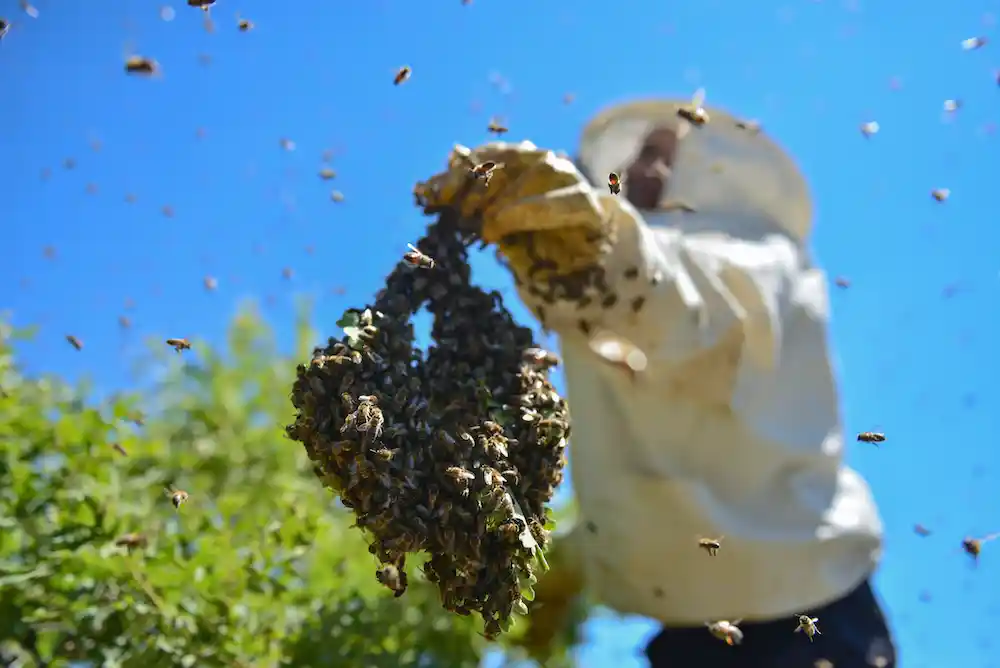
That buzzing in your wall seems like something you could handle with a quick trip to the hardware store. A can of spray, maybe some caulk, and the problem disappears, right? Unfortunately, DIY bee removal rarely ends that simply, and the consequences of getting it wrong range from painful stings to costly property damage.
Before you grab that ladder, it helps to know exactly what you’re up against. We’ll walk through the real risks of tackling bees yourself, explain why colonies keep coming back after failed attempts, and cover what professional removal actually involves so you can make the safest choice for your home and family.
When you spot bees entering a gap in your wall or clustering near your roofline, your first instinct might be to handle it yourself. A quick trip to the hardware store, a can of spray, and the problem seems solved. Unfortunately, DIY bee removal rarely works out that way.
Disturbing a hive without proper training triggers a defensive response from the colony. Guard bees release alarm pheromones that signal others to attack, and within seconds, you can find yourself facing hundreds of agitated bees. Store-bought sprays and homemade traps might kill some bees on contact, but they rarely reach the queen or the brood hidden deep inside the structure.
What happens next is the frustrating part. The surviving colony rebuilds, or the leftover honeycomb attracts a brand-new swarm to the same spot. Meanwhile, you’ve been stung, spent money on products that didn’t work, and the bees are still there.
Tip: If you’re seeing bees disappear into a hole in your home rather than just flying around your yard, you’re likely dealing with an established colony inside the structure. This situation calls for professional help.
Bees are generally calm when they’re out foraging for pollen. You can walk right past them in your garden without any trouble. However, the moment you threaten their hive, their behavior changes completely.
A single honeybee sting is painful but manageable for most people. The real danger comes from multiple stings. When you disturb a colony, you’re not dealing with one or two bees. You’re facing thousands of them, all programmed to protect their queen. Each sting delivers venom and marks you with pheromones that tell other bees exactly where to aim.
For people with bee allergies, even one sting can trigger anaphylaxis. This severe allergic reaction causes throat swelling, difficulty breathing, and a dangerous drop in blood pressure. Without immediate treatment, anaphylaxis can be fatal. The tricky part is that allergies can develop over time, so even if you’ve been stung before without serious problems, your next encounter could be different.
Unknown allergies: Many people don’t discover their bee allergy until a serious sting event
Bees don’t just move in and sit quietly. An active colony produces honeycomb, wax, and stored honey at a surprising rate. Over a single season, a hive inside your wall can grow to weigh several pounds. All of that material stays behind when a DIY attempt fails to remove the entire colony.
Abandoned honeycomb creates problems you might not expect. In warm weather, the wax melts and honey seeps through drywall, leaving sticky stains on your ceilings and walls. The sweet smell attracts ants, beetles, roaches, and even rodents looking for an easy food source. What started as a bee problem becomes a pest problem.
There’s also the risk of damaging your home during removal. Cutting into the wrong section of a wall, spraying water near electrical wiring, or using pesticides in enclosed spaces can create hazards far worse than the original infestation. Professional technicians know how to locate hives precisely using thermal imaging and experience, then extract them with minimal impact to your structure.
One of the most common complaints we hear is, “I got rid of the bees, but they came back.” This happens because DIY methods rarely address the root of the problem.
The queen is the key. She’s the only bee in the colony that lays eggs, and she stays deep inside the hive where sprays and traps can’t reach her. As long as the queen survives, the colony survives. Worker bees will rebuild around her, and within weeks, you’re right back where you started.
Pheromones also play a major role in return infestations. Bees leave chemical markers throughout their hive that can linger for months after the colony is gone. Scout bees from other colonies pick up on these scent trails and recognize the location as a proven nesting site. Without neutralizing the pheromones and sealing every entry point, your property remains a target for future swarms.
Professional removal addresses both issues:
Hiring a trained specialist offers advantages that go well beyond avoiding stings. Professionals arrive equipped with commercial-grade protective suits designed to withstand aggressive colonies, smokers to calm the bees, and specialized vacuum equipment that captures bees without crushing them.
| Feature | DIY Removal | Professional Service |
| Safety | High sting risk | Protected by specialized gear |
| Effectiveness | Often incomplete | Full colony and queen removal |
| Long-term cost | Recurring infestations | One-time solution with prevention |
| Property protection | Potential structural damage | Minimal impact to your home |
| Bee preservation | Usually lethal | Live relocation available |
Beyond the removal itself, professionals provide lasting solutions. A thorough inspection identifies how bees entered your structure in the first place. Sealing those vulnerabilities and applying natural repellents discourages future scouts from targeting your property. This comprehensive approach is what separates a temporary fix from a permanent solution.
Honeybees are essential pollinators that play a critical role in our food supply and ecosystem. Exterminating a colony eliminates the immediate problem, but it also contributes to declining bee populations. Many homeowners prefer a humane alternative when the situation allows for it.
Live relocation involves carefully transferring the entire colony into a transport box. The queen, workers, and brood are moved together to a local apiary or pollination ground where they can continue their work. This process requires skill and proper timing, as rushing can leave the queen behind or stress the colony beyond recovery.
Not every situation allows for live removal. Africanized bee colonies, which are more aggressive than European honeybees, sometimes require different methods. Hives in extremely difficult locations may also limit options. A qualified technician can assess your specific circumstances and recommend the most responsible approach for your situation.
Some situations clearly call for professional help, while others might resolve on their own. Knowing the difference can save you time, money, and potential injury.
A small cluster of bees resting on a tree branch for a few hours is often just a swarm in transit. Scout bees are out searching for a permanent home, and the group may move on by evening. However, if bees remain in the same spot for more than 24 hours or you see them entering and exiting a hole in your structure, they’re likely establishing a permanent colony.
Call a specialist when you notice:
Early intervention makes removal easier and less expensive. A swarm that arrived yesterday is far simpler to relocate than a colony that’s been building a comb inside your attic for three months. The longer you wait, the larger the hive grows, and the more difficult extraction becomes.
At Bee Removal Pros, we’ve spent over a decade handling every type of bee situation across Southern California. Our technicians arrive with the right tools, training, and local knowledge to resolve your problem quickly, often the same day you call.
We specialize in live bee removal, transferring colonies to our pollination grounds whenever possible. After extraction, we remove all honeycomb and wax, neutralize pheromones, and seal entry points to prevent future infestations. For wasp and yellow jacket nests, we provide thorough inspections to ensure no secondary nests remain hidden on your property.
Hundreds of Temecula Valley homeowners have trusted us to restore safety and comfort to their homes. Our consistent 5-star feedback reflects our commitment to fast response, clear communication, and effective results. When bees show up on your property, you don’t have to face them alone.
Q: How much does professional bee removal cost compared to DIY?
A: Professional removal typically ranges from $150 to $500, depending on hive location and size. While DIY supplies might cost $50 initially, failed attempts often lead to repeated purchases, property repairs, and eventually hiring a professional anyway. The total expense of DIY often exceeds the cost of calling a specialist from the start.
Q: Can I remove a small bee nest myself?
A: A tiny paper wasp nest under an eave might be manageable with caution and proper timing, such as treating it at night when wasps are less active. However, honeybee hives contain thousands of bees even when they appear small from the outside. Honeybee removal is best left to professionals who can ensure complete extraction and prevent return visits.
Q: Are bee removal services available on weekends?
A: Many professional services, including Bee Removal Pros, offer same-day and weekend availability. Bee emergencies don’t follow a schedule, and neither do we. If you discover bees on a Saturday afternoon, give us a call, and we can often be there within hours.